
1. How the voice is produced
Our whole body can be seen as a spectacular sound-making machine: the heartbeat, breathing, the sound our stomach makes when we are hungry or digesting. The voice, however, is the most complex and sophisticated sound our body produces, and we can shape it and have full control over it.
The voice comes from a basic sound generated in the larynx, called phonation. The larynx sits in the neck and is a tube made of cartilage. The vocal folds are the structures that produce the raw sound. The name “vocal cords” is inaccurate, because they are not little strings but folds of muscle.
There are only two vocal folds, located inside the larynx. They move apart to let air pass to the lungs, and they come together and vibrate to produce phonation. Air is therefore essential to produce the voice; we can say it is the fuel of phonation. Without air we could not set the vocal folds vibrating.
The main job of the larynx, however, is not to produce the voice but to protect the lungs from harmful agents. When the larynx closes completely and lets absolutely nothing reach the lungs, this is called laryngeal sealing. Producing the voice is a secondary function.

2. The vocal folds
Producing the voice follows a sequence of steps. First we breathe in, taking air into the lungs; at that moment the vocal folds move away from the midline and let the air in. When we make a sound, the vocal folds move toward the midline, controlling and holding back the air leaving the lungs as we begin to breathe out. As the air passes through the larynx, it sets the nearby vocal folds vibrating: they close and open in a very fast sequence, in what are called vibratory cycles. The faster these cycles, the higher the frequency of the sound, that is, the higher the pitch of the voice.
Attention! The sound the larynx produces is not the sound we hear. It is just a buzz, a bit like the engine noise a child makes when imitating a car. That sound then passes through a series of resonance cavities that work like natural loudspeakers, formed by the larynx, pharynx, mouth, paranasal sinuses and nose. These resonance cavities amplify the sound, which is very weak when it leaves the vocal folds.
The different sounds of everyday speech, vowels and consonants, are produced in the cavities above the larynx through changes in the articulators, the structures inside the resonance cavities. Sounds are articulated mainly in the mouth, through movements of the tongue, lips, jaw, teeth and palate.
For the singing voice we use the same structures that produce the speaking voice, but with different adjustments to meet the needs of singing.
Let us use a few parameters to compare the singing and speaking voice: posture, breathing, phonation, resonance and projection, vocal timbre, articulation of speech sounds and pauses, speed and rhythm.
Did you know?
The fundamental frequency of the female voice is around 220 Hz, and of the male voice around 110 Hz. Hz is short for hertz, the unit that measures the frequency of sound-wave vibrations.
In normal, involuntary breathing we take in about 500 cc (cubic centimeters) of air; when speaking, about 1,500 cc; and when singing, about 3,000 to 4,000 cc.
3. The well-placed voice
We often hear people say that someone “places” their voice to speak or sing. What does that actually mean? At first it sounds like something extraordinary, and sometimes we are even told that only people with a “gift” can do it. In fact, a well-placed voice simply means using it correctly and appropriately, as vocal physiology requires. It means working with nature, not against it or forcing it. It means breathing correctly, producing sound without strain and letting it resonate, so that we get the best vocal performance with the least effort.
In general we use our voice incorrectly and so fail to explore all its beauty and qualities. Vocal work requires great care. Placing a voice is above all a personal process that deals directly with a person’s inner life, intellect and psyche. If you are taking up vocal study, whether for speaking or singing, you should have a goal in mind: to improve yourself or your image, and to be properly prepared for vocal work as a singer, presenter, speaker, teacher or any of the many careers that rely on the voice as an essential tool.
The voice is the audible expression of our feelings and our personality, constantly registering the impact of every emotion. It is a living instrument, part of each of us, of the way we are, feel and express our ideas and feelings. Placing the voice, then, is much more than exercising muscles. It is really about growing as a person and finding your own balance, without losing sight of your goal. The art of singing is the result of all this combined with muscular work in all the organs of the vocal apparatus, so that they are controlled and used correctly to give their best, without going against the nature of the vocal apparatus or leading it to fatigue or injury, seeking the best results with the least effort, all in perfect balance and technique.
Practice all the recommended exercises intelligently and carefully, following a safe path toward a well-placed voice.
4. Getting to know the respiratory system
When we breathe, our cells absorb oxygen and release carbon dioxide. In humans, oxygen has to be carried to the cells somehow, and that is done by the respiratory and circulatory systems. The first captures oxygen from the atmosphere and brings it to the lungs. The second carries it to the tissues, and in the opposite direction carries the carbon dioxide produced in the cells back to the lungs. So there are two closely linked kinds of respiration: external respiration, the gas exchange between the air in the lungs and the blood, where the blood gives up carbon dioxide and receives oxygen; and internal respiration, which happens deep in the body, between the blood and the tissues.
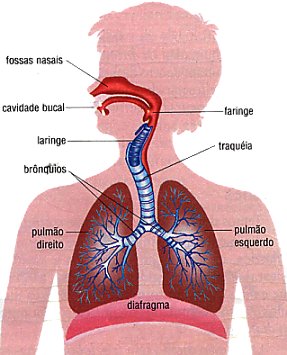
The respiratory system is made up of the following parts, which we will study one by one: the nose (or nasal cavity), pharynx, larynx (where the voice is born), trachea, bronchi, lungs and pleura, and the diaphragm.
Before we study these parts, let us exercise our breathing. The purpose of breathing exercises is to master the breathing mechanism and bring it under the control of your will. When you breathe in, do you really take the air in? Usually people raise their shoulders, do not open their nostrils enough, and sniff instead of inhaling, without expanding the lower part of the chest.
5. The nose
The nose is made of cartilage and divided into two cavities by a wall called the nasal septum. Its job is to take in air and lead it to the lungs. The two nasal cavities (nostrils) connect to the pharynx. The inside of the nose is lined with mucous membrane and hairs that protect it from foreign bodies. Because the mucous membrane has a rich blood supply, it also moistens and warms the air before it reaches the lower airways, the lungs. The nose has two functions: breathing and smell.

6. The pharynx
Also called the throat, the pharynx is a muscular and membranous passage located behind the nasal cavities and the mouth. The nasal cavities connect to the pharynx through two oval openings called choanae. The mouth connects to it through the isthmus of the fauces. In its lower part, the pharynx connects to the larynx and the esophagus. It lets food pass to the esophagus and the air we breathe pass to the larynx. These two paths cross, but they do not work at the same time. The pharynx is very important in shaping oral sounds, because it is a resonance chamber.

7. The larynx
The larynx is located at the front and center of the neck. It is a passage with a cartilage framework that can be felt through the bump it makes under the skin. It is made of the following cartilages: thyroid, cricoid, arytenoid and epiglottis. The epiglottis, a single cartilage, is the flap that lowers over the opening of the larynx when we swallow, protecting it from food. It is located behind the base of the tongue and the hyoid bone.

The larynx produces the voice. This is where the voice is born, when air coming from the lungs puts tension on the vocal folds, which vibrate in side-to-side movements, continuously and rapidly widening and narrowing the glottis. This vibration of the vocal folds is passed on to the air in the accessory cavities: the laryngeal ventricle (of Morgagni), pharynx, mouth and nose. The vocal folds are very mobile: when they are thick and relaxed they produce low sounds, and when they are tense they produce high sounds.
The larynx is the cradle of the voice. When we produce a loud, high sound, the external muscles of the larynx move it upward to stretch the vocal folds. When we produce a very low sound, it moves downward and the vocal folds relax. In high sounds the thin edges of the vocal folds come together; in low sounds they contract differently, and it is the thicker edges, with more mass, that come together.

8. The trachea and bronchi
The trachea (windpipe) is a cylindrical tube about twelve centimeters (almost five inches) long. It continues from the larynx and splits at its lower end into the two bronchi. Its main function is to let air through.
The bronchi are two tubes formed where the trachea divides, each leading into one lung. Inside the lungs, the bronchi branch into smaller and smaller tubes, the bronchioles, very fine branches that open into the alveolar ducts and end in the alveoli. Look at the diagram of the trachea, bronchi, bronchioles and alveoli.


9. The lungs
We have two lungs, one to the right and one to the left of the heart. They are essential for external respiration: it is through their walls that gas exchange takes place between the inhaled air and the blood. Each lung has a more or less concave base, an apex and three surfaces: costal, medial and diaphragmatic. The apex points upward, next to the first rib. One surface faces the ribs, another the mediastinum and the other the diaphragm.
The right lung is divided into three lobes: upper, middle and lower. The left lung has two: upper and lower. To fit into a small, narrow space, the lungs fold and wrinkle as much as possible.

10. The diaphragm
The diaphragm is a thin, sheet-like muscle that separates the chest cavity from the abdominal cavity. It has the shape of a dome, concave on its underside.
When we breathe in, it contracts and moves down as the rib cage expands, pressing on the abdominal organs at the same time.
When we breathe out, it relaxes, and the pressure of the abdominal muscles makes the abdominal organs push it back into place. The diaphragm is the main muscle of inhalation, along with others such as the pectoralis major and minor and the serratus anterior.

When relaxed, the exhalation muscles play no role in exhalation during everyday, vital breathing. In singing, however, they become important.
11. Breathing
When we breathe, three phenomena happen at the same time: mechanical phenomena, air entering and then leaving the lungs; physical phenomena, warming and evaporation; and chemical phenomena, gas exchange.
When we breathe in, the air travels down through the airways to the pulmonary alveoli. The gases in these alveoli take the opposite path and are breathed out.
As we have seen, vital breathing does not depend on our will and happens automatically. When we breathe in, the diaphragm lowers, its dome flattens out, and the lungs expand as they fill with air. When we breathe out, that is, expel the air, the lungs and the rib cage get smaller and the diaphragm returns to its position. It is the reverse of inhalation. Learning to breathe correctly is not just a recommendation for those who want to become singers; it is essential for all of us and for life itself.
In singing, breathing must be controlled according to the will of the singer. Exhalation becomes much longer in the singing voice than in the speaking voice, and inhalation a little shorter. Everything depends on the musical phrase being performed. A voice will never show all its artistic qualities if breathing is not appropriate and very well executed.
When sound is produced correctly, no air is wasted, so having large lungs or a big chest does not help. You need to know how to use the air you took in. In some moments of singing, a great deal of air is needed in the short gaps between phrases; when this happens we use what is called mixed breathing (nose and mouth). I recommend it only in places that are not too cold or polluted with cigarette smoke or dust. Inhalation should be normal, without exaggeration, calm and unhurried. With correct breathing, a person can sustain a note in the middle of the voice for more than ten seconds, and up to 20 seconds with a little training. This comes only from saving air, that is, from making good use of lung capacity.
12. The mechanics of breathing
When we are born, we breathe correctly. Watch a baby breathing and put your hand on its belly: only the belly moves. Over time we pick up the habit of puffing out our chest when we breathe. That is wrong, because what should move is the diaphragm, not the bones. So let us learn to breathe correctly again.
There are 3 (three) types of breathing:
- Abdominal. (The predominant type, essential for singing.)
- Lower costal, in which the lower ribs do most of the movement. (Also used in singing, but less often.)
- Upper costal or clavicular, with the chest rising. (Very rarely used in singing; it is best avoided.)
Always breathe in through the nose, because that is where the air is warmed before it reaches the throat. To sing, you do not need to take in a lot of air; you need to know how to let it out economically.


13. Test your breathing
Let us find out whether your breathing is sufficient:
- Breathe twenty times through both nostrils, normally, neither slowly nor quickly. Sit on a chair with your body upright (or stand, if you prefer), cover one nostril and repeat. Now cover the other nostril and repeat again.
- If you can do every stage of the test without changes in rhythm or discomfort, you should not have breathing problems. Also do the test lying down, first on your back and then on your stomach. If you have any difficulty, see a specialist, a doctor, for guidance.
- On this blog we will exercise your respiratory system a lot. Do not worry if you cannot do an exercise at first. See a specialist only if the difficulties persist. And remember: if you smoke, your breathing is probably already affected.